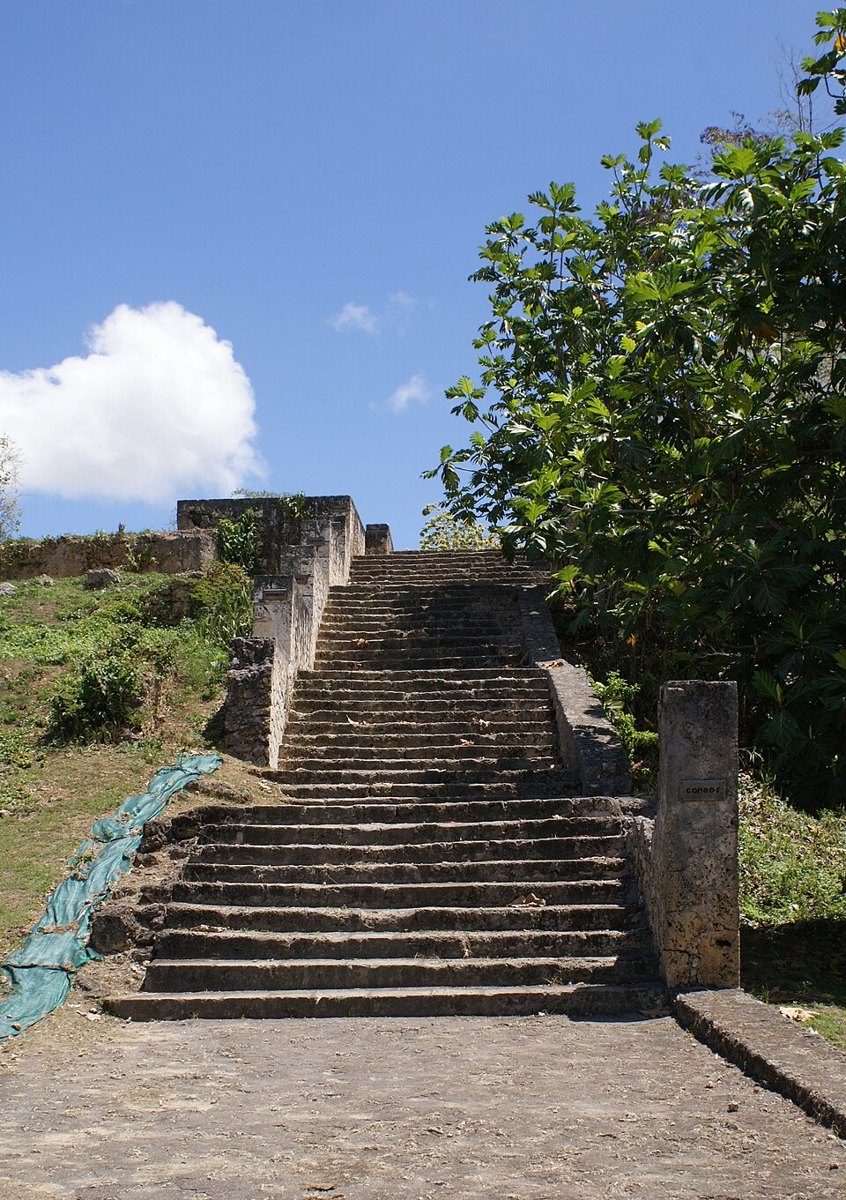
Marches des Esclaves, Petit-Canal — Kim Hansen · CC BY-SA 3.0
5 January 2026 · 4 min
Updated on 03/11/2026 · Original article: 27/11/2025
The date above follows the editorial calendar; the content was revised on the update date.
In Petit-Canal, the Marches des Esclaves and the memorials invite you, first and foremost, to stop, read and listen. Exploring them means considering both the history of slavery and how it is passed on today; it cannot be reduced to a photograph of a staircase. This guide suggests questions for a respectful visit, a continuation through the town centre and a pace that allows room for reflection, without turning monuments, testimonies and oral accounts into an oversimplified history.
Approaching the Marches as a place for passing on history
In Petit-Canal, starting with the Marches des Esclaves gives the visit a clear focus: taking time to understand before adding more stops. This site is presented alongside the surrounding memorials in the local account of slavery and abolition. Look at the whole setting, the inscriptions and the information provided, rather than focusing solely on the shape of the staircase.
A place of remembrance does not speak only of the past to which it refers. It also says something about how a society passes on this history and chooses to commemorate it. This dual perspective encourages precise questions: what does the monument commemorate, what information accompanies the site, and which source allows you to explore further? It avoids treating a photograph as a sufficient summary of a complex history.
Making room for sources and difficult questions
A thoughtful visit distinguishes between a surviving historical feature, a commemorative monument and an orally transmitted account. These forms may coexist on the same site without carrying the same weight as evidence. When listening to an explanation, ask straightforwardly where the information comes from and how it is known. This approach does not diminish the importance of the place; it helps you speak about it more accurately after your visit.
With children, start with the words encountered on site and adapt explanations to their age, without organising role play around slavery. Leave room for questions and for matters that will need an answer later. With adults, a pause after reading an information panel may be preferable to a running commentary. Everyone should be able to absorb what they discover without being rushed into producing a reaction or an image to share.
Planning a respectful itinerary around remembrance
Plan your outing around one main site and a chosen follow-up stop, rather than a checklist of monuments. Before adding a historic site, confirm that it is open and that information is available to help you understand it. A name on a map or a photograph of ruins is neither an invitation to enter nor proof of the function attributed to the building.
After this first part, a walk through the town centre’s public spaces can offer a transition. It is a reminder that Petit-Canal is also an inhabited municipality, with a daily life that extends beyond the tourist gaze on its heritage. A break at shops that are open offers a change of pace without erasing what has just been learnt.
If you then wish to explore the wetlands, treat this stage as a separate outing, with access and guiding arrangements confirmed. Interpretation can discuss the connection between remembrance, the economy of the past and the landscape, but this does not justify presenting nature as a static backdrop. To conclude the day, keep in mind one documented fact and one question to explore further: it is a simple way to extend the visit without turning a shared history into an oversimplified account.
Starting with the place of remembrance
The tourist office links the Marches des Esclaves and the surrounding memorials to the history of slavery and its abolition in Guadeloupe. Take time to read the available information. A guide can explain the context and interpretations, without reducing the history to a photograph of a staircase.
Avoiding oversimplified accounts
A place of remembrance may combine physical traces, commemorations and oral transmission. Distinguish what is documented from what belongs to an account or an interpretation. Do not attribute a date, a figure or a function to a monument without a reference; ask where you can consult heritage information.
Continuing through open spaces
After the visit, choose a walk through the town centre or another site listed by the tourist office, confirming access and visiting arrangements. Respect residents’ peace and quiet and places of worship or commemoration. Ask permission before photographing someone.
A day at your own pace
Plan suitable travel and return arrangements, water and a break. The accessibility of the steps and paths should be checked against the group’s needs. You can add an exploration of the wetlands with appropriate guidance; this remains a separate outing, not unrestricted passage to any riverbank.
Reference sources
Stay in Grande-Terre
Our homes in Le Moule and Saint-François.